Georg Kneer lives with asthma in Germany and is a patient expert from the EFA member German Allergy and Asthma Association (DAAB). Through EFA, he is also part of the European Lung Health Group. Georg spoke to us about what good lung health care looks like for patients, where gaps still remain in Germany, and how patients can use the WHO Resolution on Lung Health to advocate for change.

What does good lung health care mean to you as someone living with asthma?
As a person living with asthma, I do not want to receive support only when my breathing gets worse. I want to know what I can do myself to maintain my lung health in the long term, recognise deterioration at an early stage, and respond appropriately in an emergency. For this, I need a personal lung health plan – one that is clear, tailored to my individual needs, and developed together with my healthcare professionals. It should not only include my medication, but also my individual triggers, warning signs, inhaler technique, physical activity, vaccinations, relevant environmental and occupational exposures, and clear steps to take in an emergency.
Germany already has many structures for asthma care. Where do you still see gaps?
Germany already has many good structures in place: clinical guidelines, disease management programmes, specialised care, and effective treatments. From my perspective, the key gap is less about a lack of knowledge and more about consistent implementation. Two important examples are the written self-management plan and the regular assessment of inhaler technique. Although both are part of the Disease Management Programme, the 2024 DMP Quality Report shows that these measures are implemented in only around 66–68% of patients. This means that roughly one in three patients does not consistently receive these essential elements of asthma care. This demonstrates that recommendations alone are not enough – they need to reliably reach the individual patient. Patient organisations have an important role to play here, making sure governments follow through on their commitments. The WHO Resolution on Lung Health gives us a tool to ask what has been done and call for the changes patients still need.
What would help make care more consistent?
Primary care physicians, pulmonologists, hospitals and patients should work from a shared framework, so that information and concrete recommendations do not get lost at the interfaces between different parts of the healthcare system. And success should not be measured solely by whether exacerbations or hospitalisations are avoided, but also by whether people with asthma can sleep well, work, exercise and participate fully in society.
What does the WHO Resolution on Lung Health mean for patients and patient organisations?
For patients, the Resolution gives us a stronger basis to ask what is actually happening in our own countries. Are people getting the information and support they need? Are prevention, diagnosis, treatment and long-term care connected? Are existing recommendations really reaching patients? It can help patient organisations identify where the gaps are and use those gaps in discussions with national decision-makers.
What would you like to see happen next?
For me, lung health therefore means more than simply treating disease. It means preserving health and empowering people to live independently and confidently with their condition. Germany already has many of the necessary building blocks. A national lung health plan could help bring these existing resources together, strengthen implementation, and ensure that every patient knows: What can I do to protect my lungs – and what should I do when my condition gets worse?
Turn the WHO Lung Health Resolution into action
The WHO Lung Health Resolution gives patients and patient organisations a tool to ask what is happening in their own countries: Are people getting diagnosed early enough? Can they access the treatment and follow-up they need? Are prevention and rehabilitation part of routine care? And are patients involved in the decisions that affect them?
The European Lung Health Group has developed a patient explainer video showing how the Resolution can be used in national advocacy, helping patients identify gaps, ask the right questions and hold governments to the commitments they have already made.
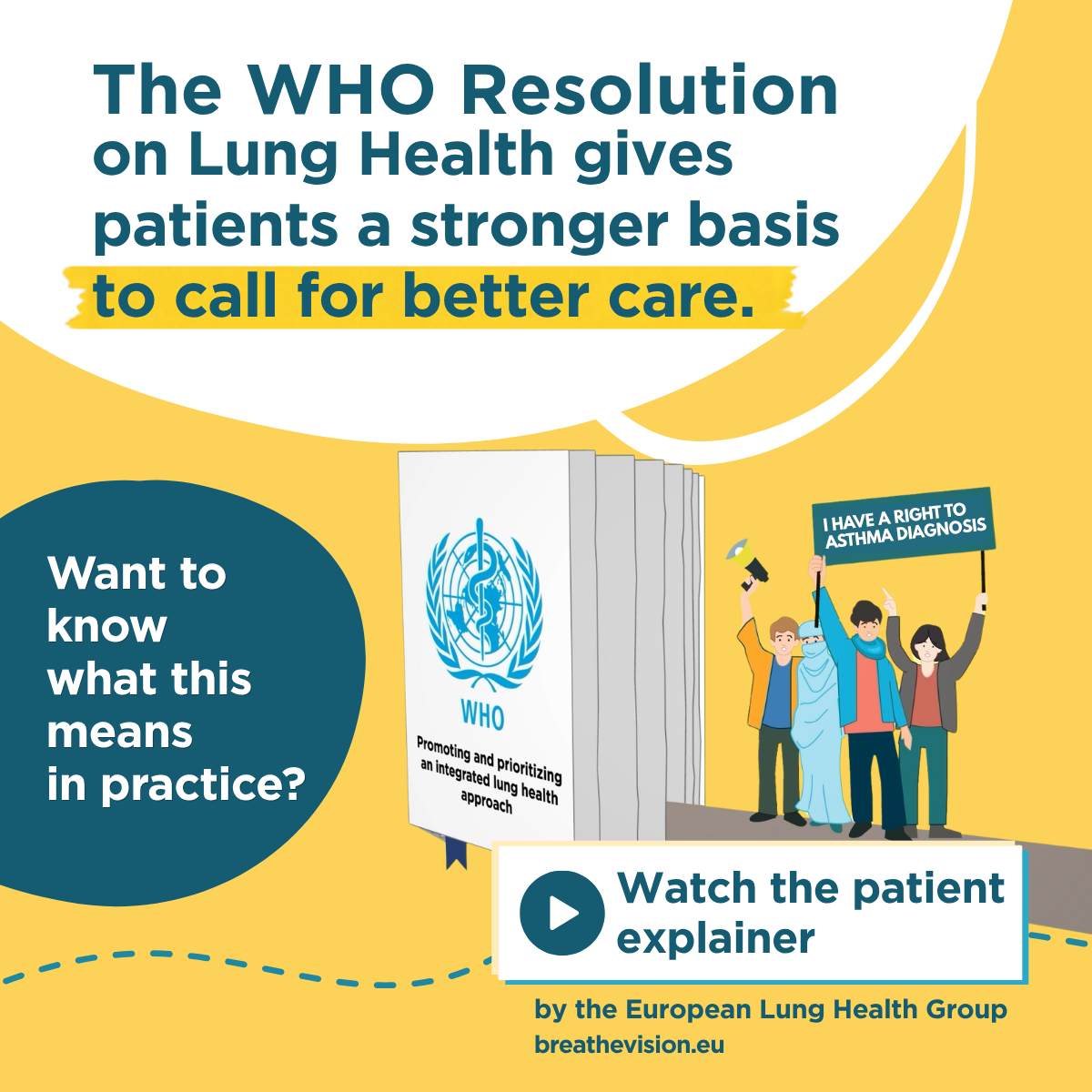
Watch the patient explainer:
How patients can use the WHO Resolution on Lung Health
But national action also needs a stronger European framework. Respiratory health is shaped by EU decisions on clean air, tobacco and nicotine, healthcare, research, inequalities and many other areas. Today, those policies are still too fragmented.
Through the #KeepBreathing campaign, the European Lung Health Group is calling for a European Lung Health Plan to bring these areas together and turn the WHO commitment into coordinated action across Europe.
The call focuses on stronger prevention, earlier diagnosis, equitable care, meaningful patient involvement, research and innovation, and long-term investment and accountability.
See why Europe needs a European Lung Health Plan:
Why Europe needs a European Lung Health Plan – infographic
For patients like Georg, that ultimately comes back to a very simple question: how can every person living with a respiratory condition get the knowledge, care and support they need to protect their lungs and live well?
That is what the WHO Resolution now asks countries to deliver and what Europe needs to help make a reality. Our policy is to #KeepBreathing, what’s yours?